
Newsletter
We send our members regular email updates about conferences, events, competitions and topics related to Japanese studies scholarship. If you have any relevant news to share please contact the Secretary Dr Satoshi Nambu. So that we can send your information in a timely manner please try to allow four weeks’ notice on date-driven events.
2027 JSAA-ASAJ Joint International Conference
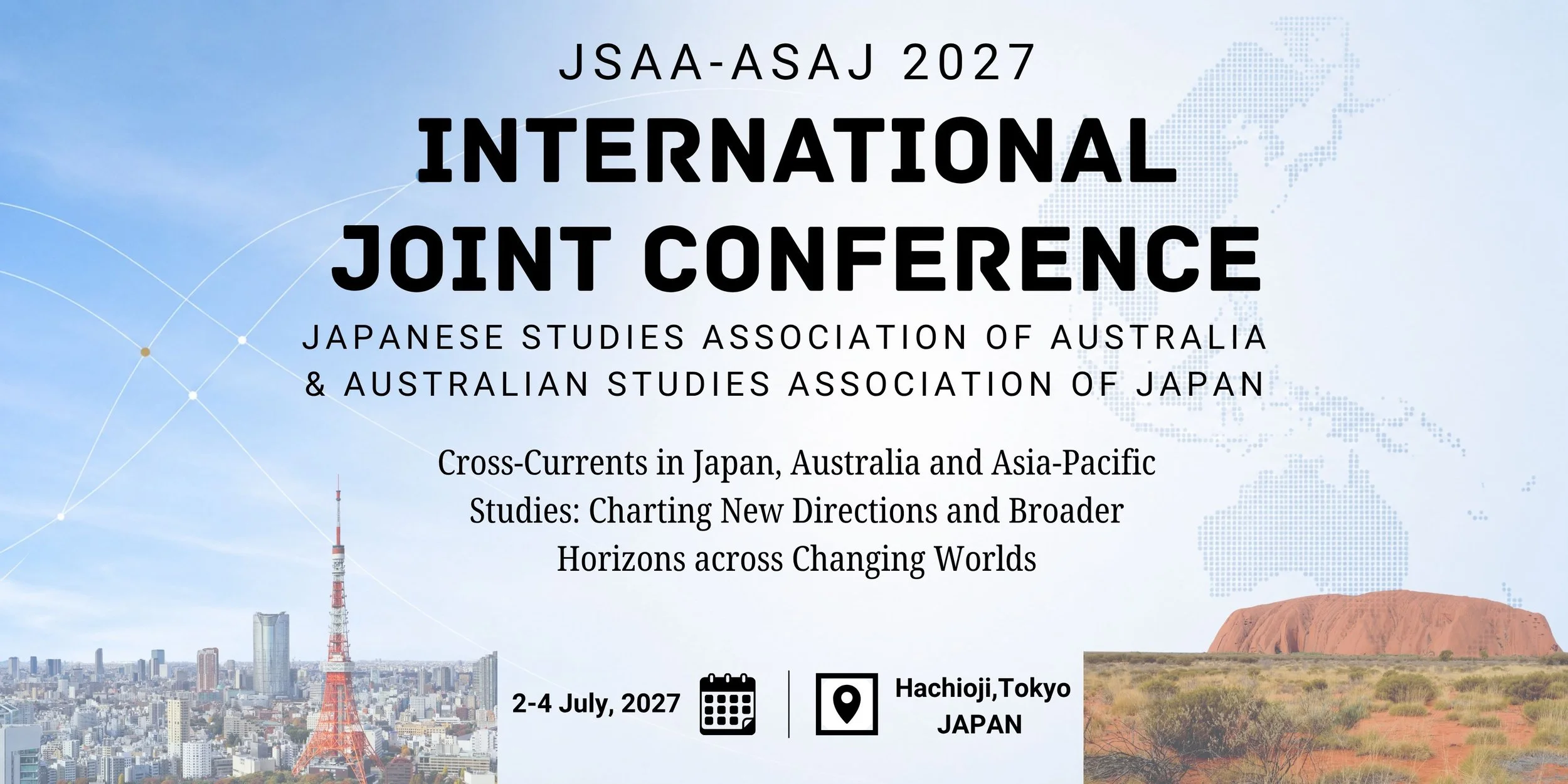
The Japanese Studies Association of Australia (JSAA) and the Australian Studies Association of Japan (ASAJ) warmly invite proposals for the 2027 JSAA-ASAJ Joint International Conference, to be held at Tokyo Tama Mirai Messe, Hachioji, Tokyo, from Friday 2 July to Sunday 4 July 2027.
The conference theme is “Cross-Currents in Japan, Australia and the Asia-Pacific Studies: Charting New Directions and Broader Horizons across Changing Worlds.” The conference will bring together scholars working across Japanese Studies, Australian Studies, Asia-Pacific Studies, and related fields to consider how these areas of inquiry might be rethought beyond narrowly national or bilateral frameworks.
We are pleased to confirm the following keynote speakers and symposium participants: Tessa Morris-Suzuki (Australian National University), David Chapman (The University of Queensland), Shin Takahashi (Monash University), Emi Otsuji (University of Technology Sydney) and Paula Gerber (Monash University; The University of Tokyo). The conference will also include individual papers, organized panels, poster presentations, and other formats, including book sessions, art-based presentations, and workshop-style sessions.
We especially encourage graduate students and early-career researchers (HDR/ECR) to apply. A postgraduate and early-career researcher workshop is scheduled for the first day of the conference, Friday 2 July 2027, and travel grants will be available for selected doctoral students and early-career researchers.
Submissions are accepted from 1 September to 31 October 2026. Full details, including the call for papers and submission forms, are available on the conference website, which includes both Japanese and English pages:
https://conference.wdc-jp.com/australianstudies/jsaa-asaj2027/
While this is a joint conference between JSAA and ASAJ, and as reflected in the conference theme, we warmly welcome submissions from scholars working in Japan, Australia, across the Asia-Pacific, East Asia, Southeast Asia, and globally more generally.
The 2027 JSAA-ASAJ Joint International Conference Organising Committee
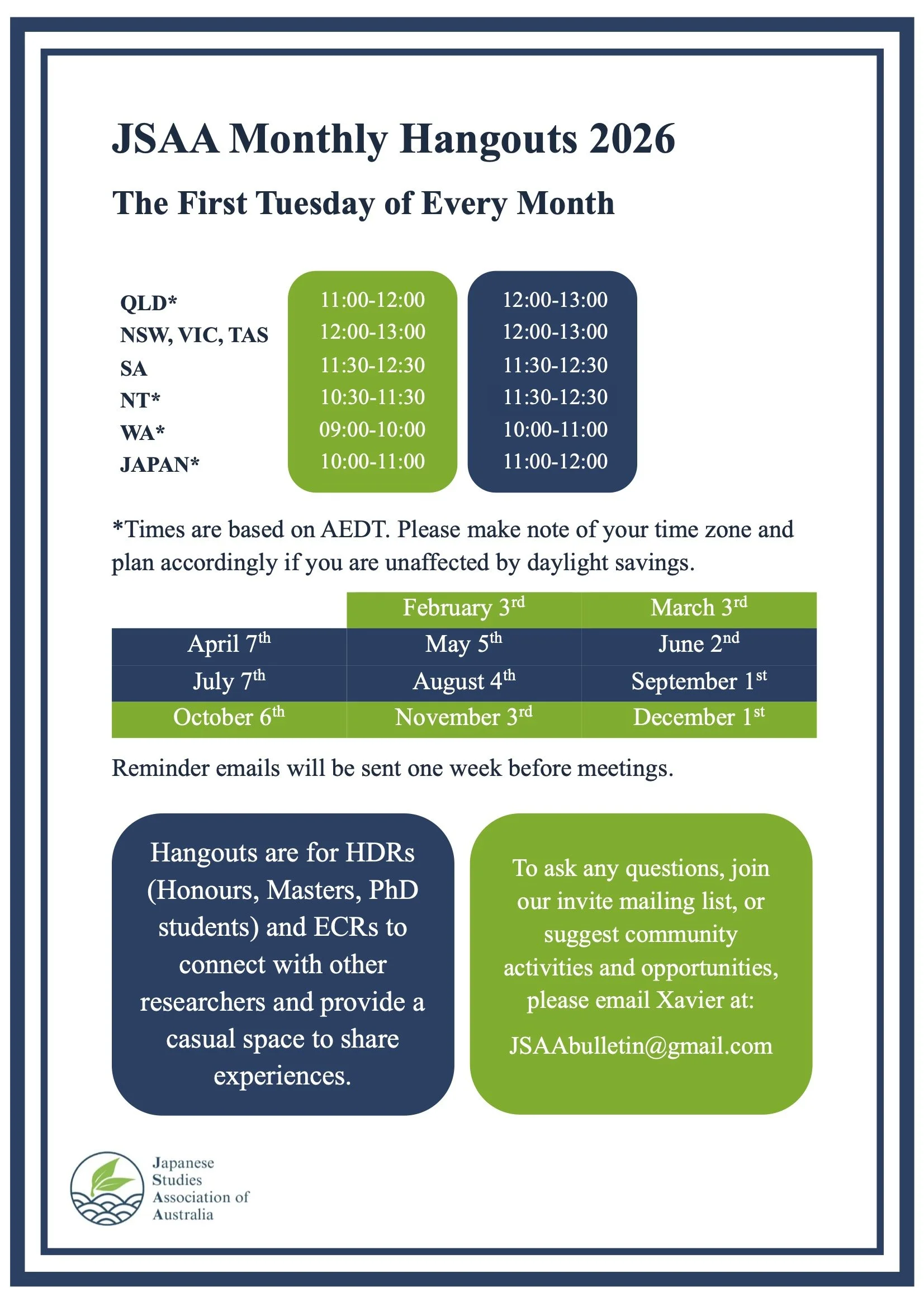
JSAA HDR/ Honours/ ECR Monthly Virtual Hangout
Next meeting: OCTOBER 6th at 11:00-12:00 AEST and 12:00-13:00 AEDT (due to daylight savings).
The JSAA runs a monthly virtual hangout for HDRs, Honours students and ECRs from any discipline whose research interests include Japanese studies. It's a very informal group - ultimately a network - wherein we discuss research challenges, achievements, share intel, reading recommendations and more.
All HDRs, ECRs and Honours students are welcome
(you do not need to be a member of the JSAA).
We meet via Zoom on the first Tuesday of each month.
If you are an HDR interested in joining and are not currently on the HDR group mailing list, please contact Xavier Svane via jsaabulletin@gmail.com.
NB: Please remember time changes due to daylight saving.
A response by members of the Japanese Studies Association of Australia (JSAA) to the 2026 Report on the:
Parliamentary Inquiry into Building Asia Capability in Australia through the education system and beyond
The JSAA collaboratively contributed a statement to the inquiry earlier this year. As an association we are convinced of the importance of ‘Asia Capability’ in Australia’s future. Our website states: “The JSAA remains committed to providing a vital platform for advancing Japanese Studies in Australia, fostering scholarly exchange, and promoting a deeper understanding of Japan among Australian academics, students and the broader community.”
The introduction of this newly released report relates that fewer and fewer students are learning a second language and the numbers of students engaging with Asian studies and languages is now at the lowest level since 1965 (1.8).
We agree that there is a current crisis that will have future implications if it is not turned around now. The Commonwealth Government is responsible, as per the report, for providing strategic leadership to turn this reduction around (1.13).
We, members of the JSAA, argue that Asian Studies is important: not only for Australia’s ‘sovereign capacity’, but also for the ability of Australian companies and the Australian people to have a deep and influential engagement with our own region. Alongside Pacific Island regions, the Asian region includes many of our closest geographic neighbours. Language and cultural knowledge and understanding are essential for effective engagement with those neighours. We also note that the recommendations in the report do not explicitly mention Japan and the Japanese language, unlike some other languages. Alongside our comments below on avoiding the ‘splitting’ of the languages, we encourage the government to be thoughtful in future policy about its naming and non-naming of languages that are significant for Australian ‘Asia Capability’.
We would broadly affirm in the main the recommendations provided in the report and would encourage the government to implement the majority of the recommendations. We affirm in particular Recommendations 22 and 23 which recommend a strategic review of higher education funding structures and interventions, such as pairing language teaching with area studies content to assist students in developing ‘deep regional capability’. Recommendation 24 continues this theme, suggesting the study of Asia could be made a priority research area in the National Science and Research Priorities. The JSAA affirms this and other recommendations and urges the Federal Government to ensure that Asia Capability education may be a priority investment for the future. Again, it is a critical time now to support our future capability in this space.
However, there are some points as reported which we feel need further discussion. Asian languages should be encouraged as a whole, without splitting them into two groups of priority and supported languages (Recommendation 2). A two-tier system will have unintended consequences by creating a ‘languages hierarchy’ by which Australia discriminates its trading partners, and this should be avoided in favour of a more open model.
Additionally, the recommended ATAR bonus system may support higher economically advantaged schools over other schools that are not as advantaged. One thing to be considered is whether an ATAR bonus should be given at all when students do not necessarily continue their language studies at university?
Finally, the Federal Government should engage closely with the states on improving Australian Asian capability: as Ken Cruickshank has stated, ‘the federal government doesn’t run one school’.
In summary, the Federal Government’s move to reflect on new ways to safeguard and develop Asian Capability is an encouraging sign that gives us hope that the dire situation in which Asian languages (including Japanese) and Asian Studies – throughout the education system – is presently in may be turned around.
The JSAA looks forward to engaging with governments across Australia to revitalise Japanese language studies and Japan Studies within the context of support for Asian languages and Asian Studies as a whole.
This response to the recent Asia-Capability Report does not necessarily reflect the broad views of the JSAA membership.
JSAA HDR/ Honours/ ECR Monthly Virtual Hangout
Next meeting: September 1st at 12:00 - 13:00 AEST.
The JSAA runs a monthly virtual hangout for HDRs, Honours students and ECRs from any discipline whose research interests include Japanese studies. It's a very informal group - ultimately a network - wherein we discuss research challenges, achievements, share intel, reading recommendations and more.
All HDRs, ECRs and Honours students are welcome
(you do not need to be a member of the JSAA).
We meet via Zoom on the first Tuesday of each month. Our next meeting is September 1st from 12:00 to 13:00 AEST.
If you are an HDR interested in joining and are not currently on the HDR group mailing list, please contact Xavier Svane via jsaabulletin@gmail.com.